
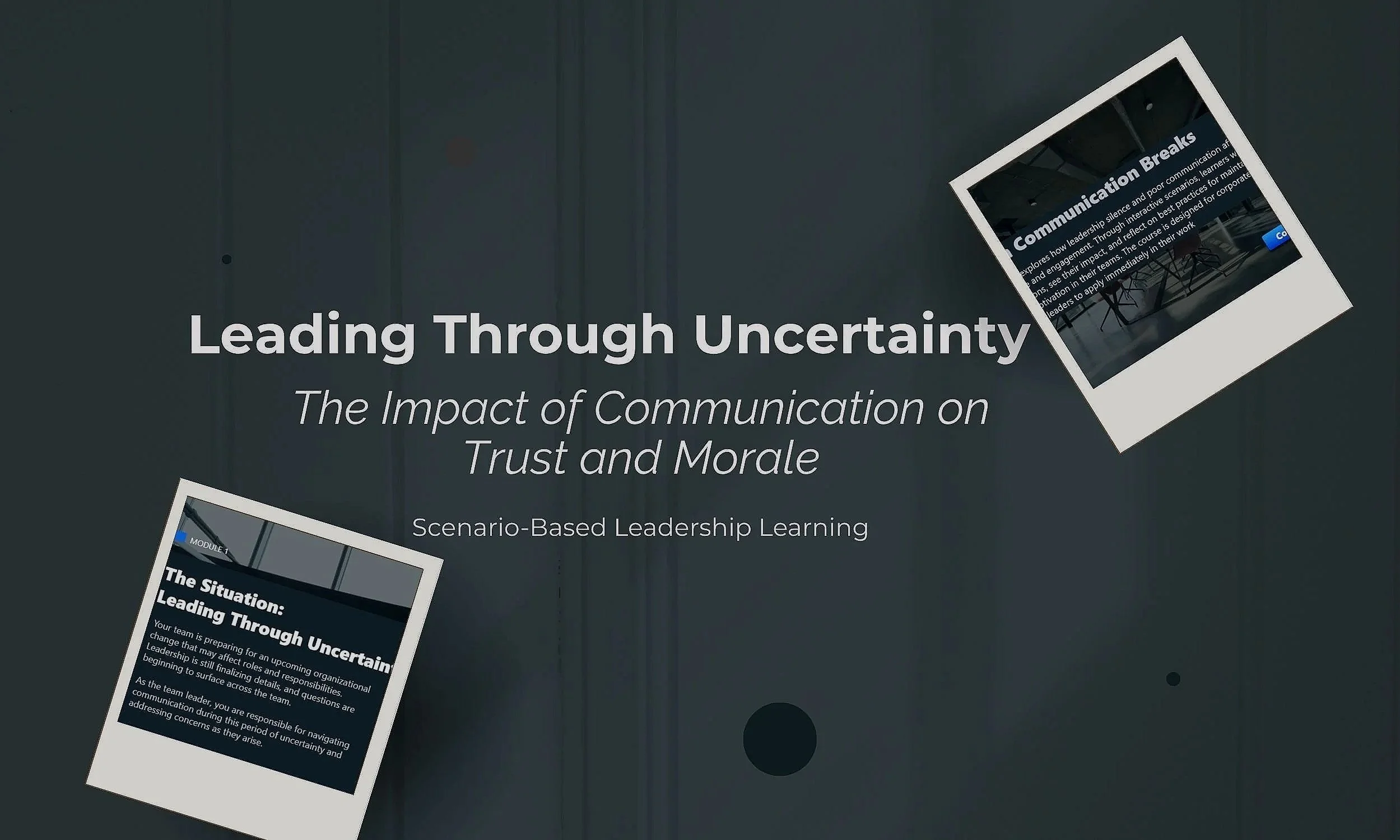
Project Overview
This scenario-based leadership learning experience explores how communication choices influence team morale and trust during periods of organizational change. Rather than presenting prescriptive rules, the experience immerses learners in realistic workplace situations that require interpretation, judgment, and reflection.
The course emphasizes how leadership presence, timing, and follow-up communication shape team engagement over time. It is designed as a non-graded, non-compliance learning experience, prioritizing applied reasoning and real-world transfer. The experience is structured as a short, multi-module professional development course rather than mandatory training.
Learning Context & Audience
Audience
Emerging and experienced leaders navigating organizational change, ambiguity, or communication breakdowns.
Context
The course simulates a workplace change scenario in which early communication gaps affect team morale and trust. Learner’s step into the role of a team leader and explore how communication choices influence engagement, confidence, and trust recovery across two connected modules. The experience allows learners to observe both immediate and longer-term effects of leadership communication.
Instructional Approach
This project was designed using the ADDIE model, with particular emphasis on analysis, design, and evaluation through reflection rather than assessment. The instructional strategy prioritizes interpretation and meaning-making over recall or rule-following.
Key instructional principles include:
Scenario-based learning grounded in realistic workplace situations
Judgment-driven learning rather than quiz-based validation
Intentional absence of “right” or “wrong” language to mirror leadership complexity
Clear narrative progression across modules to support deeper understanding
Visual restraint to keep focus on decision-making and interpretation
Rather than testing recall, the experience encourages learners to examine how leadership communication is perceived, how trust is influenced by follow-up actions, and how leadership presence shapes engagement over time.
Module Structure
Module 1: Communication During Uncertainty
The first module introduces the organizational change scenario and explores how leadership communication during uncertainty influences team morale. Learners consider multiple leadership responses, observe their impact, and reflect on how tone, timing, and acknowledgment affect engagement.
Key elements include:
Scenario setup and leadership decision-making
Cause-and-effect exploration of communication choices
A team morale checkpoint highlighting downstream effects
Leadership insight synthesizing observed patterns
Reflection prompting application beyond the scenario
Module 2: Repairing Trust Through Leadership Communication
The second module builds directly on the first by focusing on what leaders do after communication gaps occur. Rather than re-teaching concepts, this module explores how trust repair unfolds through acknowledgment, clarity, and ongoing leadership presence.
Key elements include:
A follow-up scenario showing the team’s state after change
A leadership communication interaction focused on continued presence rather than choice comparison
A scenario-based checkpoint using a drag-and-drop interaction to demonstrate applied understanding without grading
A leadership insight synthesizing patterns observed across the scenario
A scenario review grounding the learner in observable outcomes
Reflection encouraging learners to connect insights to their own leadership practice
A final “Bringing It Forward” slide providing intentional closure and learning transfer
Check for Understanding
Rather than using a traditional quiz, the course includes non-graded checkpoint interactions designed to demonstrate applied judgment. Learners connect leadership actions to their potential impact on morale and trust recovery and receive explanatory feedback.
This approach reinforces learning while maintaining a reflective tone and avoids positioning the experience as evaluative or compliance-driven. The focus remains on interpretation, consequence, and professional reasoning.
Visual & Interaction Design
Visual and interaction design decisions were made intentionally to support clarity, realism, and professionalism:
Neutral, corporate visual style
Consistent typography and color system
Primary text color: #1F2937
Secondary text color: #6B7280
Blue reserved for primary progression actions
Grey used for secondary or exit actions
Characters used purposefully to support meaning rather than decoration
Minimal animation to avoid distraction
Navigation was designed to feel intentional and respectful of the reflective nature of the content. The experience concludes with a quiet return-to-start option rather than a forced restart or completion screen.
Tools & Technology
Authoring Tool: Articulate Storyline
Design Focus: Scenario logic, interaction design, and narrative flow
Accessibility Considerations: Clear contrast, readable text sizing, restrained animation, and intuitive navigation
Outcomes & Rationale
This project demonstrates the ability to:
Design reflective, scenario-based leadership learning experiences
Apply instructional design theory without over-reliance on assessment
Balance learner autonomy with structured guidance
Build cohesive, multi-module learning narratives
Translate leadership development theory into practical learning design
Create portfolio-ready work aligned with real organizational needs
The experience emphasizes judgment, awareness, and application, aligning with modern leadership development practices rather than rule-based training.
Why This Project Matters
Leadership communication is rarely about choosing the “correct” message. It is about timing, acknowledgment, consistency, and presence. Leading Through Uncertainty: The Impact of Communication on Trust and Morale reflects this reality by allowing learners to explore nuance, observe impact over time, and reflect on how trust is built or repaired through everyday leadership actions.
The course mirrors how leadership learning occurs in real organizational contexts and demonstrates an instructional design approach grounded in realism, empathy, and professional judgment.